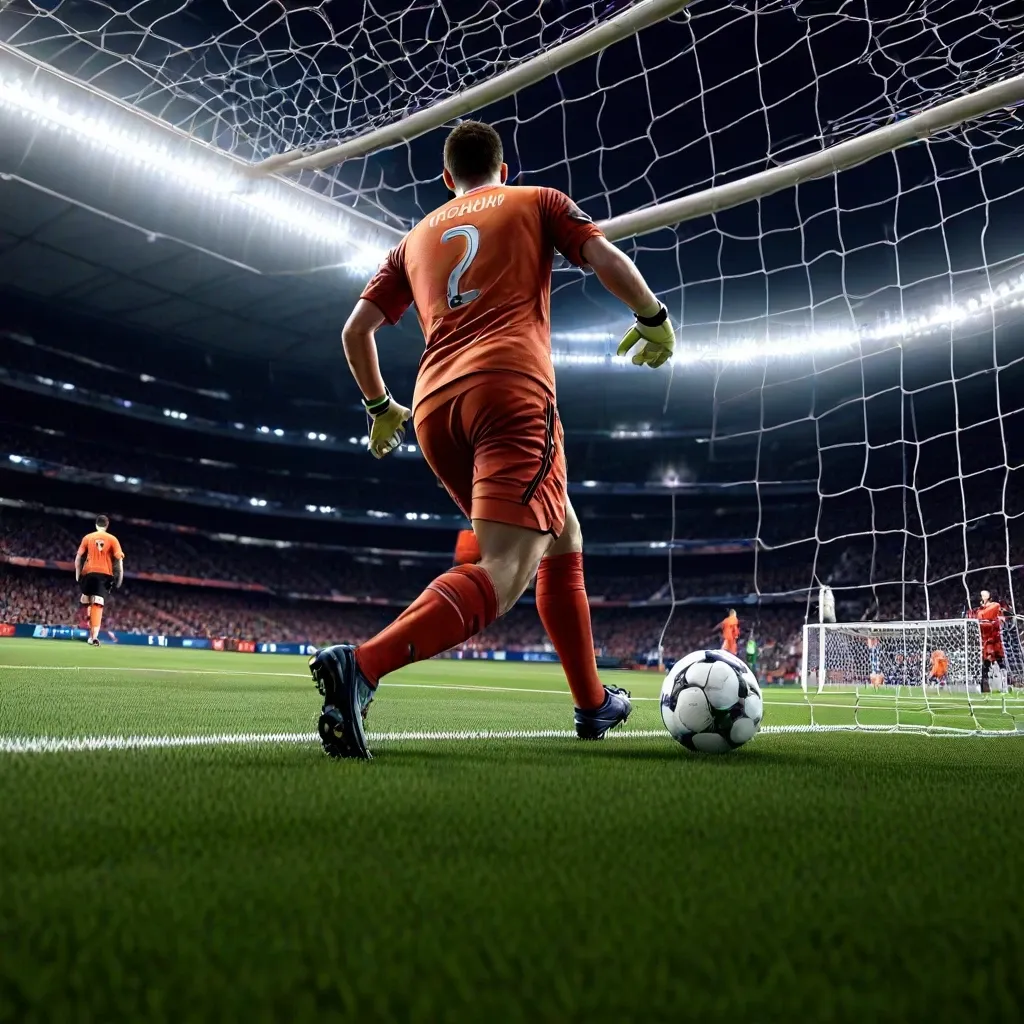
Picture this: a packed stadium, roaring fans, the score deadlocked after 120 minutes of grueling soccer. It all comes down to this – the dreaded penalty shootout. You’ve seen it before: heroes become goats, and underdogs rise to glory, seemingly decided by a coin flip. Remember that heart-stopping moment when a star player skies their shot over the bar? Or when the underdog goalkeeper suddenly transforms into an impenetrable wall?
As someone who’s spent way too many hours dissecting the beautiful game, from nail-biting World Cup deciders to local league showdowns, it’s easy to get caught up in the drama. But the question always lingers: is the penalty shootout a pure lottery? Is it truly just a pressure cooker where skill evaporates and randomness reigns supreme?
At first glance, it appears totally unpredictable. Yet, beneath the surface, data whispers secrets and patterns emerge. Predicting the outcome of a penalty shootout isn’t about having psychic powers; it’s about understanding the subtle blend of psychology, statistics, and strategy. Prepare yourself, because you’re about to discover insights and actionable strategies that might just give you an edge the next time you find yourself on the edge of your seat during a penalty shootout.
The Illusion of Randomness: Deconstructing the Penalty Shootout
The penalty shootout. It’s the ultimate test of nerve, a moment where dreams are made and shattered. But beneath the surface of what seems like pure, unadulterated luck lies a complex interplay of factors that significantly influence the outcome of each kick. This perceived randomness is, in reality, an illusion. To think that a penalty shootout is a coin flip is to ignore the subtle, yet powerful, forces at play.
Consider the immense pressure bearing down on each player. It’s not just about striking the ball well; it’s about performing under the gaze of millions, knowing that a single mistake can cost your team everything. This pressure can manifest in altered technique, hesitant movements, and ultimately, missed shots. Skill, of course, is paramount. Years of training and perfecting shooting technique are essential, but even the most technically gifted players can crumble under pressure. Think about instances where star players, known for their clinical finishing, have faltered in crucial penalty shootouts. This isn’t simply bad luck; it’s the pressure overriding ingrained skill.
Team strength also plays a role, albeit indirectly. A team that has dominated the match beforehand may carry a psychological advantage into the shootout, while a team that has been under constant pressure might be mentally fatigued. Momentum is another key factor. A save by the goalkeeper can electrify a team, while a missed penalty can deflate morale. You can perceive each element as intertwined, creating a narrative that slowly shifts the odds, dismantling the illusion of randomness with every kick. The penalty shootout is not chaos. Each element contributes to the final result.
Beyond Chance: Identifying Key Influences
Situational awareness dictates how a player perceives pressure, influencing decision-making. You must immediately process information about the goalkeeper’s tendencies, the crowd’s reaction, and the overall scoreline. This is all before even approaching the ball. Combine this with the precise motor skills required to execute a penalty kick, and you begin to understand the sheer complexity involved. Every element must work in sync, and if one falters, the outcome is compromised.
But the pitch itself can be a factor, too!. A slick surface due to rain can alter your footing, impacting your run-up and strike. A gust of wind can affect the ball’s trajectory. You could even perceive the sun glaring in the goalkeeper’s eyes. The elements, combined with the mental and physical strain, move outcomes away from the realm of chance.
Therefore, a penalty shootout is influenced by pressure, technique, team strength, situational awareness, decision-making, and even the weather. You have to consider each element when you think that it’s ‘random’. Each element contributes to the final result, highlighting a complex dynamic far beyond simple luck.
Data and Analytics: What the Numbers Tell Us (and What They Don’t)
Penalty shootouts are high-stakes moments where data analysis can offer valuable insights, but it’s crucial to understand both its power and its limits. Diving into penalty statistics, you’ll often encounter conversion rates, preferred shot locations, and goalkeeper tendencies. For instance, you might find that a particular player consistently aims for the left side of the goal, or that a certain goalkeeper tends to dive early. This data can inform strategy, but relying solely on past performance can be misleading.
The inherent problem lies in the small sample sizes typical of penalty shootouts. A player may have only taken a handful of penalties in high-pressure situations, making it difficult to draw definitive conclusions about their future performance. Furthermore, human behavior is rarely static. Players adapt, goalkeepers evolve, and the psychological pressure of the moment can override even the most ingrained habits. Predictive models, while sophisticated, can only account for so much. Over-interpreting data can lead you astray, causing you to bank on probabilities that crumble under the weight of real-time stress.
In many cases, you may see how a penalty taker has a favorite side. But what happens if the goalkeeper knows it? The penalty taker should know their stats, know that the goalkeeper will know it, and be prepared to do something else.
Identifying Trends and Patterns
You can actually improve situational awareness, player preparation, and decision-making in penalty shootouts by analyzing data – even if the attempts are highly contextual. Think about it – understanding the statistical probability of a player succeeding in a penalty can help you know who performs better under pressure.
Statistical analysis can show you a lot about a player’s ability to perform better under different conditions, which may help you make game-time decisions. Even though chance will always play a big role in the final score, studying and knowing their patterns can give you and your team an edge.
The Mind Games: Psychological Factors at Play
The penalty shootout. It’s not just about physical skill; it’s a brutal test of mental fortitude. The psychology in these moments is paramount, a cauldron of pressure, anxiety, and the fragile nature of confidence. A player steps up, the weight of a nation–or a team, at least–on their shoulders. Can they block out the roaring crowd, the taunting goalkeeper, the sheer finality of the kick? Anxiety tightens muscles, clouds judgment. Confidence, usually a reliable ally, can evaporate in an instant, replaced by the fear of failure. The goalkeeper, too, faces a mental battle. They attempt to predict the shooter’s move, their own confidence wavering with each stutter step. Some thrive in this high-stakes environment, channeling the pressure into laser focus; others crumble, their technique betraying them under the immense strain. Mental toughness separates the legends from the footnotes in these defining moments. The shootout becomes a psychological drama, where the mind is the ultimate playing field.
Strategies for Managing Pressure
You can take control. Visualization can be a powerful tool. Before stepping up to the spot, mentally rehearse the perfect penalty. See the ball leaving your foot, feel the satisfying connection, and visualize it hitting the back of the net. This builds confidence and programs your body for success. Then, control your breath. Slow, deep breaths calm the nervous system, reducing anxiety and sharpening focus. Practice mindfulness; stay present in the moment, blocking out distractions and focusing solely on the task at hand. By using these techniques, you can transform pressure into fuel, and face the shootout with a calm and confident mindset.
Strategies for Success: Improving Your Odds
Optimizing Training and Preparation
Success in penalty shootouts isn’t about luck; it’s about meticulous preparation and strategic execution. You can significantly improve your odds by optimizing your training regimen to simulate the intense pressure of a real shootout. This means moving beyond rote practice and incorporating realistic drills that replicate the psychological and physical demands of the moment.
Imagine standing on that penalty spot, the weight of the game on your shoulders. The roar of the crowd, the focused stare of the goalkeeper – these are elements you can and should recreate in training. Implement drills that introduce fatigue, simulate crowd noise, and even incorporate distractions to force you to maintain focus under duress. Rehearsal is paramount. Visualize success before each shot, focusing on your technique and the specific target.
Consider variations like having teammates heckle you, or requiring you to sprint to the spot before taking your shot. The goal is to condition yourself to perform consistently, regardless of the external pressures. Analyse the outcome as well, see the positive and the negative sides. Furthermore, practice under different lighting conditions, and at the different times of the day to be prepared to any scenario.

The Future of Prediction: Is AI the Answer?
Can artificial intelligence rewrite the future of sports prediction? Maybe. The rise of artificial intelligence and machine learning opens doors to a new era of predictive accuracy. Imagine algorithms dissecting every penalty shootout, player by player, examining stance, run-up speed, and even subtle facial cues. These aren’t just guesses; they’re data-driven insights drawn from vast datasets, potentially revealing patterns invisible to the human eye. Data science applied to a penalty can bring results.
Predictive algorithms, fueled by machine learning, promise to move sports analytics beyond basic statistics. Picture AI models learning from countless past shootouts, adjusting their predictions as new data streams in. The potential benefit is clear: a measurable and positive impact on team strategy, training regimes, and perhaps even the outcome of crucial matches. This offers improved insights in comparison with traditional methods.
However, the path isn’t without its bumps. The beauty of sports lies, in part, in its unpredictability. Can AI truly account for the psychological pressures of a high-stakes moment or a sudden shift in weather conditions? Can the power of data science combined with massive datasets overcome human actions? While AI offers incredible possibilities, its limitations can’t be ignored.
Conclusion
The quest to predict the unpredictable penalty shootout reveals a complex interplay of skill, strategy, and psychology. While a crystal ball remains elusive, understanding the data, employing effective strategies, and mastering the mental game can demonstrably tip the odds in your favor.
Perfect prediction will always remain out of reach, but you now possess a much clearer understanding of the key factors influencing these high-pressure situations. From analyzing goalkeeper tendencies and optimizing shot placement to controlling anxiety and embracing visualization techniques, each element contributes to a team’s overall probability of success.
Initially, you might have perceived penalty shootouts as a lottery, a matter of pure chance. However, you’ve discovered that it’s more than just luck. By implementing the strategies discussed and continuing to explore the fascinating intersection of sports science and human performance, you can approach future penalty shootouts with newfound confidence and a distinct competitive edge.